On
the island of Mangareva is the main village called Rikitea. About
1200 or so people live on this island, so there is lots of boat
traffic. Cruisers anchor here, pearl farm boat tenders head out to
their jobs, and kids learning to paddle as part of their PE are all
in the anchorage.

These
kids are just learning to paddle. We can tell be cause it is a
training boat with two hulls lashed together, so it cannot capsize.
The school probably makes them all wear life jackets. We were
cheering them on as they went past us.

Other
kids learn early. This guy was out on his dad's paddle board, just
drifting along one morning.

Big
brother takes younger brother out for a paddle in a kayak. The smoke
on shore is from burning yard trimmings, which also helps to
eliminate mosquitoes.

At
the school we saw a couple of interesting paintings. This one
depicting an oyster shell with a pearl.

Traditional
Polynesian symbols, with a tiki hidden behind the fire hydrant and a
ying & yang symbol snuck into the center of Maui's hook.

We
had many of the “Shark suckers” which look like Remoras live
under our boat when in the Rikitea anchorage. They come out anytime
we throw leftovers or compost-able veggie trimmings over the side.
They usually only eat meat, definitely not vegetarians these fish!
But fun to feed. They were like our temporary pets. The top of
their heads have a big suction cup on it and they just attach
themselves to the bottom of the boat (like we are some kind of big
shark) and wait for us to throw food overboard.

This
ship is the Claymore, which is the ship that services
Pitcarn Island. It comes here to pick up passengers who fly in, then
takes them on the 300 mile passage to the island where they stay for
the week. This is the closest airport to that island. We plan to go
there one day ourselves!!

The
main supply ship for the Gambiers is the Taporo VIII. They have just
rounded the end of the island and are coming in with a full load.

The
fairly large ship weaves its way in through the narrow channel in the
reef to get to the anchorage.

Everyone
and their uncle comes down to the dock on supply ship day to pick up
their packages from Tahiti.

The
crane is unloading 4 barrels of diesel. This is one of the main
things this ship delivers. Note the guy in the green vest over there
watching the cargo carefully.

If
you need to buy diesel, this guy in the little metal box takes your
money and gives you a receipt to take to the other guy, who then
gives you a barrel. You can only buy 50 gallon drums, so if you need
less than that, you split it with other boats. Cost, just under $250
USd for one barrel!! Expensive!! But where else you gonna get it?
No gas stations!

They
deliver their cargo and then load up the empty tanks and containers
to take back to Tahiti to refill. The 5 tall silver looking
containers under the crane body are for jet fuel. The commune has a
barge, similar to the one stacked on top of the green shipping
containers, that schleps the jet fuel from the quay in Rikitea over
to the airport motu.

Yo!
Guys in the dinghy, do you see the ship headed out?!? Tonnage wins!

In
24 hours or less from the time of arrival, the ship is headed back to
Tahiti for another load. It comes once a month.

This
is a Dutch boat called Silverland,
with our friends Marco and Mariah and their son Matis. It is their
first boat! Luckily he is a carpenter, which all old wood boats
need.

Silverland
under
sail, heading into Rikitea.

People
from all over the world arrive here, on all different types of boats.
Silverland
is one of the larger family cruisers!

The
view from one of our favorite spots in the Gambiers, Herve and
Valerie's house on Terevai. It is on the West of the island group.
That is Mangareva with the two peaks of Mount Duff on the right and
Mount Mokotu.

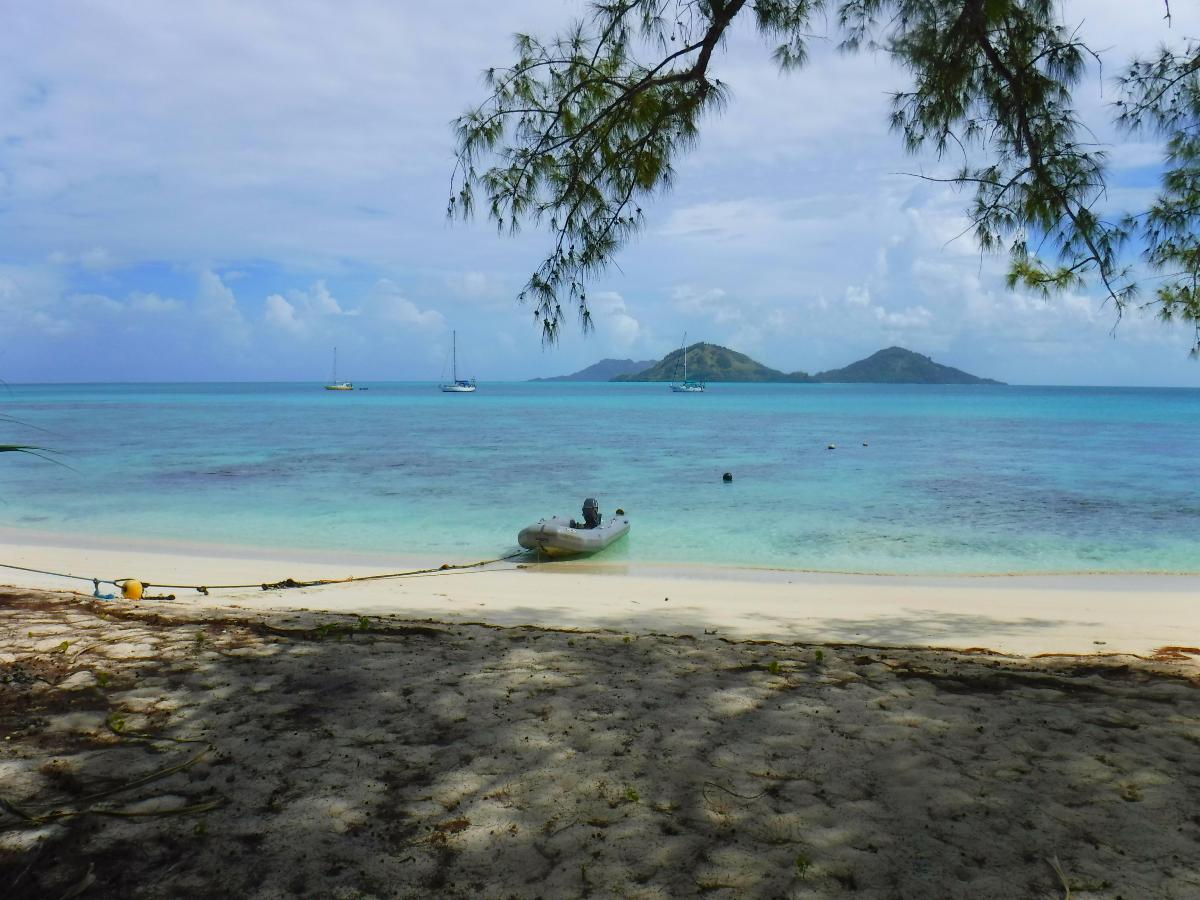
On
one of the sandy motus (an outer reef barrier island), footprints in
the sand.(reminds me of a famous poem)

The
norm is just our own footprints.

But
the birds and the crabs leave footprints too!

A
crab has just cleaned house, leaving a pile of sand by his door.

Even
the waves leave a footprint. Each time one comes ashore, it leaves a
line where it finishes its life.

Sometimes
the wave brings in shells and rocks which it deposits on the sand.
The leaves from the trees either blew out and are waiting to be
washed away with the next tide, or they came in with the last one.

Erosion
is a fascinating artful thing to see created by Mother Ocean.

A
wave washes over a rock, creating more erosion.

Another
gorgeous day in the Gambiers, but no wind means motoring to get to
the NE motus near the airport.

Looking
back at Mangareva from the NE side and the sun setting behind it in
the West.

The
sky turns pink and orange over a squall line out in the ocean to the
SW. Our time in the Gambiers is coming to an end.